Lesson 1 : Inroduction to Embedded system and computer structure
Lesson's Contents :
- Components and structure of the computer
- Comparison between the micro-processor and the micro-controller
- History of the micro-controller
- History of ARM company and its starting
- Processor family of ARM Cortex
- Instruction set structure
1- Components of the computer :
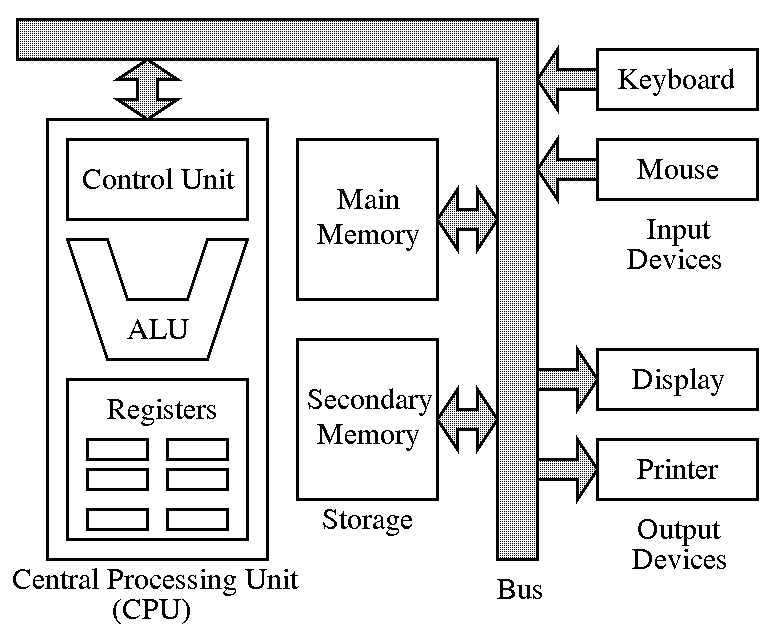
- CPU : The unit that is responsible for program implementation and the program is a group of calculations and Logical comparisons (< > =)
- RAM : Read Write memory in which the program is temporarily saved and every thing is deleted when the power supply is switched off
- ROM : Read only Memory which Our program is saved in and when the processor work the program transfered to RAM to be implemented
- Secondry memory : like hard disks
- Input and output deveices
2- Computer Architecture :
1- VON NEUMANN ARCHITECTURE :

- Codes and data of the program is saved n RAM
- Main line (Bus) for transfering data ,addresses and control orders
- Program can change it self as it is saved in a read write memory
- Easy impelementation but low performance
- Example : ARM-Cortex-M23
2- HARVARD ARCHITECTURE :

- Codes of the program can be saved in the ROM but data is saved in RAM
- 2 lines for transfering : a line for the RAM to transfer data and a line for transfering codes to ROM
- The program can change its data easily but can't change itself
- Hard implementation but higher performance
- Example : ARM-Cortex-M4
3- Difinition of the Embedded system :
- A computer which has a specific function in a bigger mechanical or electrical system
- It is named as Embedded because it is an only one device which consists of of electrical and mechanical parts together and a small computer exists inside the device
- It has a specific function so its size may be reduced , its speed may be raised and its cost may be reduced
- you should work with the Real time speed
- It has several uses and we can see a lot of Embedded systems exists today in the cars, houses, medical devices and military applications
4- Microprocessor and microcontroller :
- Microprocessor :
- The main brain in the computer system structure
- It implement orders of the program one after another in a fast speed
- example: ARM Cortex-M4
- Microcontroller :
- A small computer device which consists of all components within the microprocessor inside an electronic chip only
- example : STM32F420
:History of the microcontroller
United States of America at the invitation of INTEL, where I asked them for some integrated circuits for calculators. Among this team is an engineer named Marcian Hoff, who put forward a new proposal, which is the need to find alternative solutions for integrated circuits, in which the programs used are stored.
This proposal required more memory units in the Japanese company's project on integrated circuit design, which would be more complex with this proposal. But with time, the first microcontroller was thought of, and Marcian Hoff's idea began to be put into practice.
To achieve this idea, Frederico Faggin assisted Intel in producing the first microcontroller and obtained the right to sell it in 1971, but after purchasing a license from Busicom without knowing that it had this treasure. During this year, the 4004 microprocessor appeared on the market, containing 4 bits. At this time, the American company CTC called on INTEL and Texas Instruments to make an 8-bit microprocessor, and in 1972 the first 8-bit microprocessor appeared in the market under the name 8008, and it contained 116 kilobytes of memory and its price was about $360.
In this year, most companies realized the importance of this amazing invention in changing the future of integrated circuits, led by Motorola, which produced 6820 and 6850. In 1975, The MOS Technology Company announced the microprocessor 6501 and 6502, and its price was $25.
The engineer, Frederico Faggin, left work with INTEL and formed his own company, Zilog Inc. In 1976, he announced the Z80 microcontroller, as the interest at that time was in developing programs for the 8080, so Frederico Faggin added the possibility of compatibility with the 8080 microprocessor to the Z80, as he was executing the programs. Written specifically for the Li 8080.
With the increase in memory capacity, it also added random memory, so the Z80 achieved great success at that time. As a result, Intel upgraded the 8080 to the 8085, but it also did not stand up to the Z80. After that, many companies developed that treasure and produced many microcontrollers with enormous capabilities.
Among the companies that arose at that time was a British company called Acorn Computers Ltd, where it developed the 6502 processor in 1981. This company had ambitions and plans to design its own 32-bit processor, as the founders of the company, Sophie Wilson, wrote the instruction set for the ARM1 processor, while her colleague Steve Furber did. By working on designing an electronic chip to fit this new processor, the year was 1985, when Acorn produced its first ARM1 processor, and started designing the ARM2 processor, and the first computer containing an ARM processor was produced in 1987.
In the year 1990, ARM was established, which is an acronym for Advanced RISC Machines Ltd., as a partnership between Acorn and the well-known American company, Apple, in addition to VLSI Technology. The reason for this partnership is that Apple wanted to use ARM processors and wanted this processor to be its own and not the property of Acorn, which It was considered a competitor to it at the time, and thanks to the money of Apple and the tools of VLSI Technology, a leading company in the design of integrated circuits, and with the expertise and minds of Acorn, ARM was established. Accordingly, Apple produced the Apple Newton digital assistant and used the ARM 610 RISC processor, but unfortunately it was not successful. required and was eventually canceled on the directives of Steve Jobs in 1998.
newton pen
Apple Newton digital assistant
ARM realized that it is not possible to succeed and spread its processors inside only one device, whether it is Newton or something else, and that is why Robin Saxby, CEO of ARM at that time, introduced a new model, unlike what is followed in most companies such as Intel and Motorola, which is the intellectual property model, which guarantees ARM the rights Its intellectual property is for the company's processors, and all electronics and integrated circuit companies can use these processors. This model was one of the most important factors in the success of ARM, and it has a partnership with all electronics manufacturers instead of using its processors in only one product. Today, ARM processors are used in thousands of devices. .
Partnership with Nokia
One of the most prominent and important partnerships at that time for ARM was its partnership with mobile phone giant NOKIA. Due to some concerns I have about memory consumption, ARM produced a special 16-bit processor with less memory consumption. The Nokia 6110 was the first fruit of this partnership, as it contains A processor with an ARM7 architecture, which was adopted by ARM for mobile phones, due to the great success achieved by the Nokia 6110 phone. 165 licenses were granted for the ARM7 processor, and 10 billion electronic chips containing this processor were produced.
ARM produced ARM9 processors, then ARM9E, then ARM10, then ARM11, with a focus on reducing power consumption. Until 2005, ARM produced the ARM Cortex microprocessor family, which includes Cortex-A as an extension of ARM11, with a focus on mobile phone applications and needs. It also produced Cortex- R for real-time applications and meeting the requirements of extraordinary performance, in addition to the low-cost Cortex-M for embedded system applications. Today, ARM processors are present in all smartphones, as the company occupies 96% of the processors used in smartphones, and among the most popular phones that have ARM processors are iPhones. .
Why stm32F4 and ARM Cortex-M4 and not Arduino?
Recently, we have seen the spread of Arduino and how it provided the opportunity for many amateurs and students to enter the world of programming embedded systems and microcontrollers. However, it should be noted that Arduino is not a microcontroller, but rather an integrated development environment, as it contains 8-bit ATMega328 microcontrollers produced by Atmel. There is also an Arduino IDE that facilitates The process of programming and dealing with the microcontroller without going into many details. There are also many ready-made Arduino libraries that can be used directly and are available for many software applications. But today we're going to learn how to work with powerful 32-bit microcontrollers that are used in real embedded system applications like smartphones, watches, and cars. We also want to delve deeper into our study of these microcontrollers, as there are many details hidden in the Arduino environment to facilitate the programming process.
Comments
Post a Comment